May 29, 2022

Southern Italy + Venice, April-May 2022


Together with cabin neighbors, Katie and Randy, we began our three and a half week
Italian adventure on the Island of Sicily. It was good to be out and about again in a foreign country. We toured archeological sites and the old parts of the towns, eating fish and seafood, drinking red wine, walking/hiking/climbing, and playing Rummikub. We stayed at airbnbs, all comfortable, several with the IKEA theme and others with Grandma’s hand-me-downs. Most had balconies or outdoor areas with a view. Masks were required in all shops and museums, although many were worn with exposed noses.


Randy did all the driving which was great because some of it was very scary. One wrong turn and it was extremely difficult to get back on track again because of small one-way streets and dead ends in parking lots. Randy drove while Katie navigated using directions on her phone. I sat in the back and did my best to remain quiet. There were some very steep hills with hairpin turns and very narrow roads, also many road changes with renumbering, or no names shown at all. Towns had many roundabouts. Most challenging were the extremely steep streets that were barely the width of the car (ours was a small standard transmission Fiat). In one driving adventure, Katie and I were so terrified by the steep incline on an extremely narrow street with a sharp turn at the top that we got out and walked.  


The countryside consisted of rolling green hills with many vineyards, olive, orange, and other fruit trees. Small stone houses, many abandoned, dotted the hillsides. In a few places there were cattle and sheep, but mostly crops grew on the hills. There were lovely wildflowers, especially red poppies and tall yellow dandelion-like ones. 


Poppies by Pompeii

On Sicily we started out in Palermo, the regional capital, and then wound our way around the island in a counter clockwise direction. Leaving the airport, there were mountains, with palms and cacti next to the highway. We stayed in the old part of town where the narrow streets were made of stone. Often you couldn’t tell where one building ended and the next began. In Palermo, we had the best pastries on the whole island at a café in a church, the dolceria at Saint Caterina church, where the nuns prepared the cannoli according to the “ancient recipe,” with cannoli properly filled with whipped ricotta cheese only when ordered. 


Pastries

We visited the Puppet (marionette) Museum; there’s an old tradition from the 1500’s of puppetry in southern Italy when stories of French knights were recorded and then produced at puppet shows. The museum had over 2500 puppets from different countries. We watched part of a show where there was lots of fighting between the knights with the appropriate sounds. We also toured the impressive opera house from 1897, the third largest in Europe after Vienna and Paris. 


We were first introduced to the many cultures that have inhabited the island at the Palermo Archaeological Museum. We saw artifacts and architecture: the Palermo Stone, a “stele”(stone tablet/monument) from the times of the Pharaohs, Phoenician (25-64 BCE) objects such as sarcophagi (stone burial coffins) from the 5th century BCE. Greek statues and columns also from the 5th century BCE, and Roman objects, such as mosaics from the 1st century CE. This layering of cultures was the main archaeological experience we had of Sicily. Sicily layered cultures; later came the Byzantines (500-800s), then the Muslims with the Arab conquest (800-1000s), and the Roman Catholics with the Norman conquest in the 11h century.


We visited the Greek archaeological site in Selinunte from the 7th century BCE. There was one large temple that had been rebuilt in the 50’s, not very accurately apparently, but it was impressive, and there were ruins of other temples. We then walked to the acropolis where about 30,000 people lived with a view of the sea.


The next big archeological site was the Greek Valley of the Temples in the next town, Agrigento, founded in 582 BCE. There were many ruins of temples, but one temple, the Temple of Concordia, built in the 5th century BCE, Is beautifully preserved. Originally the building was of ground white marble stucco. Over 200,000 people lived there. The archaeological museum had an endless number of artifacts, especially exquisite drawings on vases. In all of the museums the number of artifacts was overwhelming.


Concordia Temple


We visited a Roman villa, Villa Romana del Cassale from 300 CE located in the interior, a sprawling villa, 37,000 square feet, with amazing  mosaics. Landslides sealed off the area in the 1300’s and it wasn’t excavated until the 1930’s; the mosaics of a great hunt and women athletes were found in the 1950’s. There were many rooms and apartments all with amazing mosaics, some pieces so small, the size of a fingernail. One theory is that the owner of the villa was a dealer of exotic animals which he sold to circuses.


One of the best parts of being in towns was wandering in the old sections with narrow streets and flowers and plants on the balconies. The town of Noto was probably the most impressive. It had been rebuilt after the earthquake of 1693 in a planned and consistent manner, like most towns it was built on a hillside and so there are stairs all over town. From the rooftop of our apartment, we could see much of the town.


Darlene climbing stairs to our Airbnb

From there we went to Siracusa where we saw both a Greek and a Roman theater. The Greeks built their theaters into the hillside, while the Romans built theirs freestanding. The Greek theater could hold 15,000 spectators. The Roman gladiators fought each other and it could be rather bloody so there was sand on the ground to soak up the blood. We stayed and wandered in the old part of town, Ortygia, which is an island connected to Siracusa. The cathedral has a baroque facade from 1728-53, but it was built over an ancient temple. On the side of the cathedral, you can see
the Greek columns from the 5th century BCE temple; then the Byzantines filled them in to make a church in the 6th century BCE. The Arabs created a mosque in 878, and the Normans created a fortress/church and added the crenellations on top. In the earthquake of 1693 the Norman facade fell off.


Cathedral in Ortygia

Katie had wanted to find the Jewish ritual bath, a mikvah, it took awhile, but we eventually found it.  It is about 60 feet underground. [A mikvah is a ritual purification bath that is used at a variety of times over the life of very observant Jews, such as before marriages, conversions, etc. The water in the pools must be “gathered” fresh water running freely from springs, not pumped in and not tap water.] This mikvah is the oldest surviving mikvah in Europe. Jews were in Italy since Roman times, probably first on Sicily. At some time about 135 AD, Rome expelled the Jews from Jerusalem and more Jews poured into Siracusa. It would have remained in use until Spain, having conquered Sicily, expelled the Jews from Spain and its territories in 1492.At that time, about a quarter of the population of Ortiga was Jewish.Then the mikvah was both forgotten and protected until it was excavated by accident in the 1990s.  At this time, there are no Jews on Sicily. 


We ate at one especially fine seafood restaurant, La Lisca Cucina e Bottegaso, so delicious that we returned the next night. I raved about the mussels in ginger and mint and was brought a dish compliments of the owner.The view of a  square from our apartment was very pleasant and relaxing. We then drove north to Taormina, passing the volcano Mt. Etna which has been somewhat  active lately, spitting up smoke and hot stones. In Taormina, we could see the volcano from our balcony.


Mt. Etna

We flew to Naples and then took a bus to Sorrento on the Almalfi coast. We enjoyed Sorrento, especially the apartment where we stayed surrounded by lemon trees, in fact the whole town was filled with lemon trees of different types, large ones, called citrons, bumpy ones, and ones pointed at the ends. We gathered those that had fallen from the trees in the yard and Katie made delicious lemonade. 


Sorrento was a real town compared to the other two that we visited, Positano and Almafi. Positano seemed to be an especially superficial rich tourist town. The towns are built on the hillsides and definitely very picturesque. We did our share of climbing stairs and going up and downhill. 


Amalfi Coast

Visiting the Roman archaeological site of Pompeii was a highlight of the trip. We wandered on the streets with our guide and visited the shops and small houses. So much was intact. Everything was gray stone, but originally it had been covered with ground white marble stucco. A large villa was especially impressive as we entered and observed where the office of the noble would have been and then the courtyard with greenery, and finally the rooms where guests were entertained. There were six public baths where both the rich and the poor gathered. Now the sea is three kilometers from the town, before it had been close by. Pompeii was founded in 600 BCE, an important trading town bustling with activity with 11,000 residents and busy with seamen and merchants from other places. The brothels were handy when men came into town. We saw the brothels, which had explicit stuccos of sexual positions and the prices, as the travelers would not be able to communicate their desires, nor the prostitutes able to name the prices.


Road with crosswalk

A villa

We saw the Roman theater where 5000 people could be seated, women and slaves up high. The gladiators fought one another; we also saw the small rooms where they lived as slaves.  When Vesuvius erupted in 79 CE, blowing off two thirds of its height, the pyroclastic cloud of hot gas killed most of the people and ash buried everything, 13 to 20 feet deep, crushing the top floors of the buildings. However, because it was ash and not lava, Pompeii was not incinerated and was preserved for the next 1600-1700 years. Pompeii wasn’t discovered until 1738.


In Naples we went to the archaeological museum to see the mosaics and the frescoes from Pompeii. Once again we were very impressed with the mosaics and all the work that went into creating the beautiful designs with color subtleties made with teeny tiny tiles. An amusing part of the exhibit was the collection of art with the subject of penises. Apparently, penises were the symbol of fecundity and therefore success. Statues, stuccos, and mosaics reflected this good luck charm. 


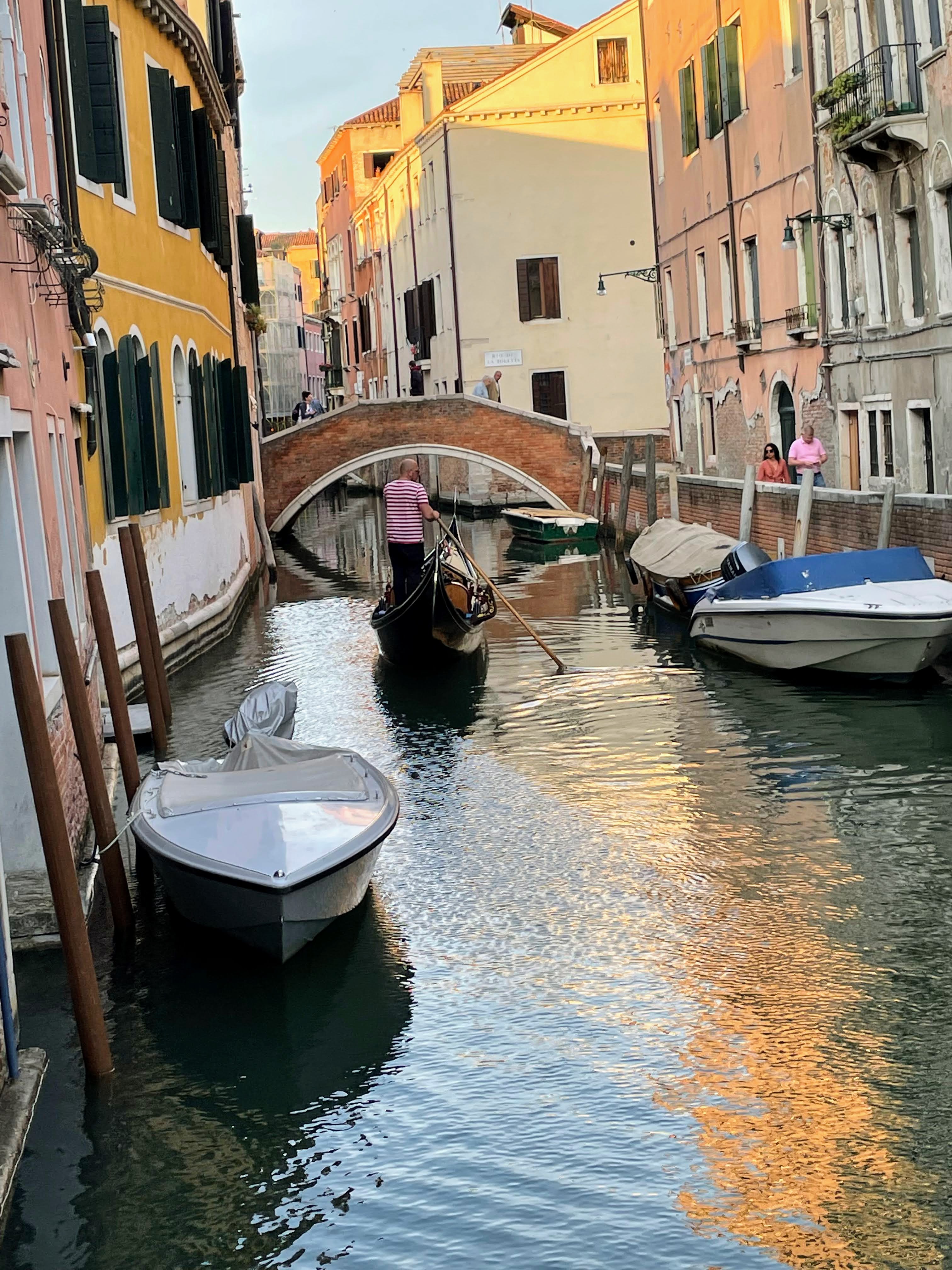
We took the fast train to Venice, a very beautiful and special city for our last few days. We wandered and took ferries and toured the Doge’s Palace in St. Mark’s Square. The extremely impressive palace was from where the government ruled all through history; it housed public offices, courtrooms, prisons, the Doge’s apartments, stables, armories. The governing men met and voted there. The ceilings and walls have paintings by famous Venetian artists. The building itself has undergone many changes and rebuilding, mainly because of fires.


Doge Palace

We spent the last two days enjoying the art at the Biennale and visiting the country pavilions. It was fascinating. The theme of the Biennale was “Milk of Dreams - life is constantly re-envisioned through the prism of imagination.”  The US pavilion with the sculptures of an African American woman, Simone Leigh, was impressive. Some of the presentations at the pavilions were rather strange and even after reading the interpretation were challenging to understand, but of course they were artists’ visions. Some of the art was especially interesting, maybe not beautiful, but it was a good experience in pleasant surroundings.


American Pavilion


?


Our  final night in Italy, we ate at Ongia, in Campo San Barnaba, a restaurant Katie and Randy had first visited in 2016. Again we had seafood and red wine, but this time finishing the dinner, our stay in Venice, and our time in Italy, with an after dinner liquor, limoncello. It was an amazing trip that we all thoroughly enjoyed.


To see photo album:

https://photos.app.goo.gl/LGFhyRWBFsKX9RmN7


 ​​


January 25, 2022

Kayaking in the Florida Everglades - January 2022


Kayaking in the Everglades was a great way to spend some days in January. I joined friends, Paula and Chuck, on a Road Scholar tour. The Everglades is a huge wetland in southern Florida which consists of many canals, some natural and some man-made. There are also rivers and lakes with a combination of freshwater, salt water and brackish water. Many areas are sawgrass prairies, which have sharp serrated edges. We kayaked for about four hours three mornings and saw plenty of alligators, very docile, soaking up the sun, but no pythons which are eating all the small animals in the area. One day we saw turtles basking in the sun. We observed orchids and air plants growing primarily on the cypress trees and live oaks (has a very small leaf). Spanish moss (not Spanish and not moss) hangs from trees. It is an epiphyte that absorbs nutrients and water through its own leaves from the air and rain.


 Paula and I shared a kayak; we had tandem kayaked before near Vancouver Island and Baja, Mexico. Most of the paddling was leisurely except for one time when we were crossing a lake and we had a strong head wind. Usually, in the  canals, there was little or no wind, current, or tide. Red Mangroves are plentiful in certain areas along the canals and one day we went through several “tunnels'' where the mangrove branches and roots form a tunnel which required steering as we passed through them; we did our best, but  banged now and again into the roots and branches. We visited a research and visitors center, Rookery Bay where we went on a tour in the forest where there were many different kinds of trees, so different from Minnesota trees. Settlers had tried to settle in the area, but the soil was bad and the bugs were impossible. We saw many water birds: egrets, blue, green, and tri-colored herons, Ibis, cormorants, king fishers, anhingas, pelicans, and vultures. We did one evening paddle where we were able to see  beautiful clouds dotting the sky as the sun was setting. As we paddled back to the landing, gleaming orange alligator eyes glared at us. 


We attended lectures in the afternoon or evening and learned about the history of the Everglades and attempts made to develop the area. People objected to the development and eventually the ideas were abandoned. It was also an area that would have been difficult to develop. The canals are not very deep and there is a limestone base. It’s partly a National Park and there is also a reserve, Big Cypress Nature Reserve, where some of the land is privately owned and motorized airboats and swamp buggies can be used, and people can hunt and fish. A big Restoration project was started in 2000 to restore, protect and preserve the Everglades.


Everglades City Is a pathetic little town where people live off of tourism and fishing. It has to be a miserable wet place in the summer. Stone Crab is a specialty found there - delicious. Only one claw is harvested on each crab, and then it grows back in about a year. We sampled those and also ate some delicious fish and seafood at different restaurants. We were well taken care of. It was an excellent tour with knowledgeable leaders, and I learned a great deal and had fun.


                                                              Red Mangrove


Cardinal Air Plant

                                                                        
                                                            Everglades City

December 05, 2019

Chile: 2019


Susan, Lynda, Glenda, Darlene


Wet and cold is a good description of our holiday in southern Chile; it was spring, but early spring. On “good” days it sprinkled intermittently, maybe a downpour and then a light shower. On bad days it poured, rain beating down hard all day or all night or both. We were, however, in a temperate rain forest much of the time so wet is not unusual. We were able to do some hiking, but not as much as we would have liked. I traveled for about a month with my three Chile teacher friends: English Sue, Scottish Lynda, and Canadian Glenda, my good friends from the late 60’s when we taught at Santiago College, and lived and traveled together. This was our fifth trip together, our third in Chile; nine years ago we had made a similar trip. At the beginning and also at the end we stayed with our good friend Erica, from England, who lives in Santiago and was also a teacher. There were some new highways, and many sections under construction. It was fun being back and exploring both familiar and new places. We also stayed at a couple of the same hostels. We did not have a set itinerary, and more or less made it up as we went along. It was early enough in the tourist season that we didn’t have to worry about reservations; many tourist spots  were still closed. We stayed in places that provided breakfast, then made sandwiches for lunch, and in the afternoon we would open a bottle of wine before going out for dinner and then finish it off while we played a game later in the evening.

We flew south to Puerto Montt and rented a car since it’s over 1000 kilometers  (620 miles) from Santiago, and we wanted to be in the south. We put about 2500 kilometers or 1500 miles on the car. We spent a few days by Lake Llanquihue at one of our favorite hostels, Zapato Amarillo, near Puerto Octay, run by a charming Swiss couple, and then headed north on two-lane highways through mostly rolling countryside with lots of cattle, and later sheep.  We passed several large lakes on our way to make a repeat visit to Judith and Roberto who live north of Pucon. We drove through small towns with large housing developments on the hillsides, this is a new phenomena, at least before they weren’t so apparent, now these small houses are crowded together having the look of “little boxes on the hillside, little boxes all the same.”

We had a lovely stay with Judith and Roberto and learned all about their business of making rolls every morning to be sold at the local grocery store. We got to eat them warm every morning with a selection of Judith’s delicious fruit jams. They also raise strawberries commercially, a new enterprise, which hopefully will be very successful as the plants mature. Since it was spring, there were plenty of spring flowers: lilacs, rhododendrons, broom, gorse, notro, a red flowering tree, and the violet blossoms of the jacaranda tree. Their beautiful property high on a hill has  fruits, vegetables, and geese, ducks, chickens, turkey, and a goat. They work very hard, but obviously enjoy their work. While in the area we visited the National Park of Huerquemue where we had spectacular views of Volcano Villarica, and then  the hot springs, Los Pozoes. Another day we drove up to the pass to Argentina where we could see Volcano Larnin and many Araucanian pine trees, also called monkey puzzle trees.
Volcano Villarica
Araucanian or Monkey Puzzle Trees and Volcano Larnin
 After Pucon, we turned around and headed south again through mountains with lots of  pine trees and eucalyptus, this time to Puerto Fuy on Lake Pirehueico where we took over the hostel, each having our own room because we were the only guests. An impressive enterprising woman owned and ran the hostel. The snow-covered Volcano Choshenco loomed in the distance; we took a boat trip across the pristine lake where the tall pine trees on cliffs extended right down to the water. There were also beautiful yellow mimosa trees on the shore. There is almost no private property on the lake, and we hardly saw any buildings. We also visited the Huilo Huilo Reserve and did some hiking there. For three evenings we ate delicious lake trout.  

Volcano Choshenco

Lake Pirehueico
Then we headed south again to Puerto Montt where we would take the Austral highway south. This highway hadn’t been built the last time we were there, and lots of construction is still going on; some places warned us of potholes. The highway goes all the way south in Chile from Puerto Montt to Punta Arenas and Tierra del Fuego (2500 kilometers, over 1500 miles). We took a short ferry, then drove to Hornopirén where we ended up staying the night in a cold cabin, but after a delicious meal in a warm and cozy restaurant. Getting on the ferry the next day was going to be a matter of luck, and we had it. We were third on the wait list and we managed to squeeze on. Glenda had a long chat with two young enthusiastic French women cyclists who were going all the way south. The ferry took us half the day past mountains and fish farms in very isolated areas. Then off the ferry to wait for the next ferry. We chatted with a number of people waiting in their vehicles, ate peanuts offered by a nut salesman and tried the stalks of the giant rhubarb-like plant, gunnera.
Our white Chev just got squeezed on.
We eventually got to Puerto Gonzales where there was next to nothing and started on the gravel road which eventually became paved, to Chaiten. It was very wet with waterfalls, huge ferns, gunnera (rhubarb) and other plants. We arrived cold and damp in Chaiten and gravitated to the once elegant hotel on the main street. Chaiten is a pathetic little flat town on a gulf of the Pacific; it has the look and feel of a pioneer town. There had been a volcanic eruption in 2008 and it had taken three years for basic services to be restored. Before the eruption, 5000 people lived in the town, but now there are 3000. Because of low clouds, we never saw the volcano. The woman who owned the hotel had lived there 40 years. She was anxious to get us warmed up and brought propane stoves into our rooms. We requested hot water, but never got a consistent warm flow. She served us excellent breakfasts and made sure we had lots of food available to make lunches. We were almost the only guests in the hotel.

Chaiten
We did a hike in the rain to see a towering 4000-year-old Alerce or Patagonia Cypress tree. We also checked out part of the new Pumalín National Park that consist of more than 2 million acres (810,000 hectares) of wilderness in Chile and Argentina that Douglas Tomkins and his second wife, Kris, (North Face and Patagonia) had  bought and conserved  in the 1990’s. “They focused on park creation, wildlife recovery, ecological agriculture and activism with the goal of saving biodiversity” (Wikipedia). In 2017 the park was gifted to Chile. We also drove to an impressive suspension bridge 45 kilometers south of Chaiten. Our plan had been to keep heading south, but rain was predicted everyday and clouds covered the mountains and glaciers, so we decided to escape and take the ferry west to the island of Chiloé.


Alerce tree
On Chiloé Island we spent several days in the capital city of Castro in a crazy pink hotel with blue trim; we visited some markets and wandered in an area where the houses were on stilts called patafitos, and were even invited into a home. The tide is huge so when it is low tide it is really low and when it is high tide it’s about six meters (almost 20 feet) higher.  When we left Castro, we headed to an island where several UNESCO designated wooden churches are located. They have wooden shingles and are quite lovely. Meanwhile I continued my collection of photos of different colored and shaped shingles on houses. We eventually made it to Puerto Varas where we found a wonderful German hotel. Germans settled Southern Chile in the 1850’s, and also after the wars. Puerto Varas is very upscale with nice hotels, apartment buildings, shopping centers and a boardwalk along the lake. We were back to Lake Llanquihue, where we had started. We decided to drive to Ensenada; “a beautiful village with a lovely beach” which ended up being a string of mostly closed resorts and cabins strung out on the highway. We found a cabin near a beach and once we got it warm with the wood-burning stove, it was very pleasant, although mornings were cold until we got the stove going again.

The oldest church, Achao, 1730
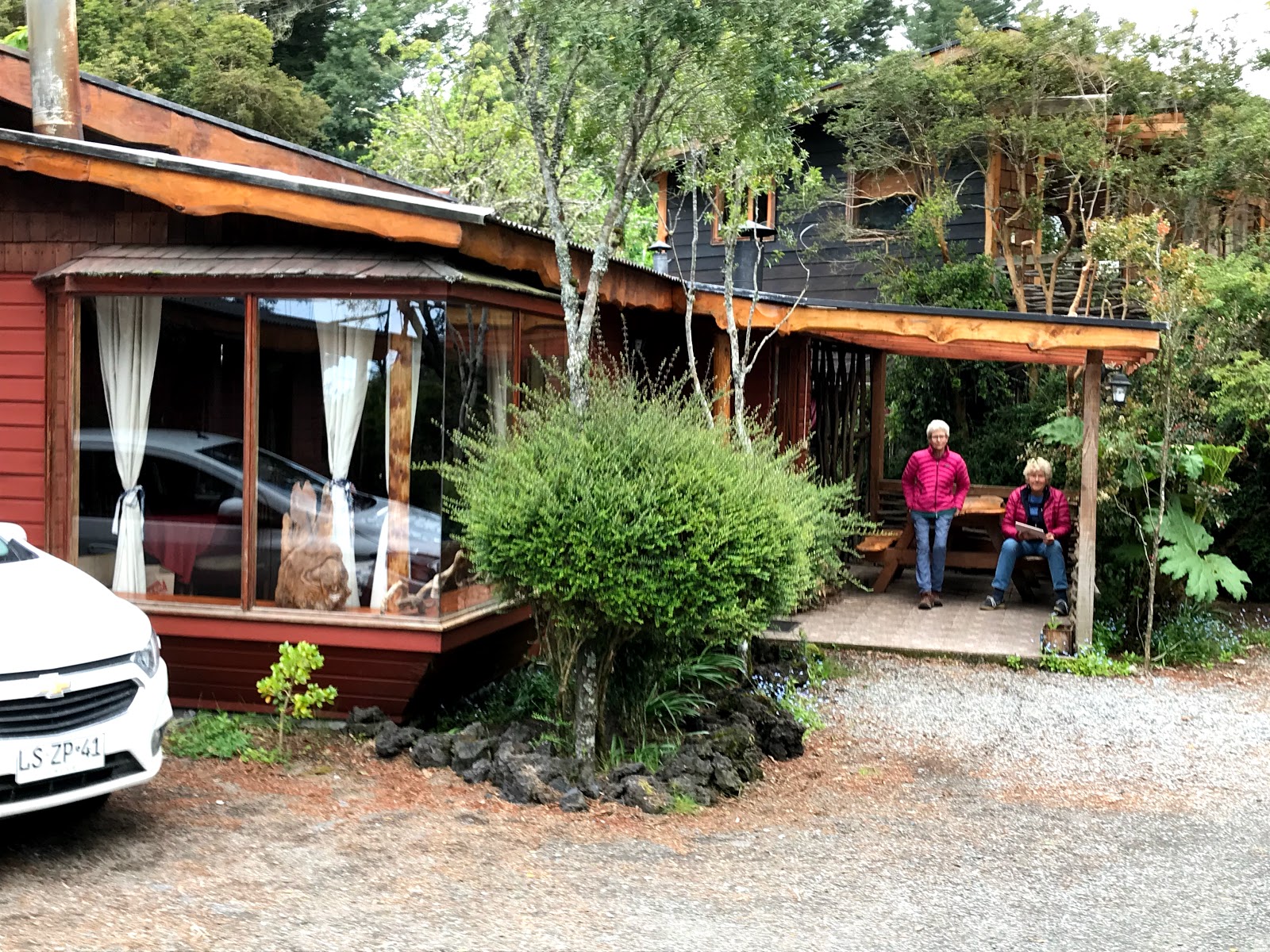
Our cabin
Lake Lllanquihue
We ended up staying there five nights and had fun exploring the area, reading and playing games. There was a small hiking trail nearby that we went on several times, and walked to the beach with interesting clouds hanging over the volcanoes of Osorno and Calbuco. Early in the morning it was extremely calm and the water undulated inward, later waves would appear and often white caps. Sometimes one could see the volcanoes, other times they were enshrouded with clouds.  We took the boat trip from Petrohué to Peulla, which we had taken last time on Lake Todos Los Santos. We had seen the spectacular volcanoes then and we hoped to repeat that experience, so looking at the weather forecast, we chose the one sunny clear day we would have that week. And it was! Clear and sunny and beautiful, and we saw the three volcanoes, Osorno, Puntiaguido, and Tronador, plus other snow-capped mountains. This lake is well populated with over 100 private properties. It was used as a trade route between Agentina and Chile at the turn of the century and tourism started in 1910. It was a lovely day trip over to the hotel complex of Peulla and back.

Volcano Osorno

Volcano Puntiaguido
Another day we took the highway to Cochamó. We drove along estuary Reloncavi with many fish farms. Eleven kilometers of the road were under construction and I got to drive on the soft and muddy road with loose gravel, with not only pot holes, but signs that warned of “profound holes.” There were also dump trucks entering and exiting and other heavy construction machines on the road. The little town was calm and quiet with few people in sight. We walked around a bit, ate lunch, and then returned to Ensenada.

A couple of days later we were off to Santiago where temperatures were in the 80’s. Demonstrations in Santiago started while we were there. and elsewhere in the country; they were even occurring in the small towns that we visited.  One of the main areas of protest was near Erica’s apartment and we could hear the crowds of people and also see smoke. It became violent with vandalism, and traffic lights didn’t work so crossing the street was often a challenge. It started with a raise of subway and bus fares, but then soon extended to other injustices, low pensions, poor education, poor health service, and people were demands for a new constitution. The rich were getting richer, and the poor, poorer. I think issues were slowly getting resolved, at least there was progress in the right direction. Time will tell.

A vandalized subway entrance.
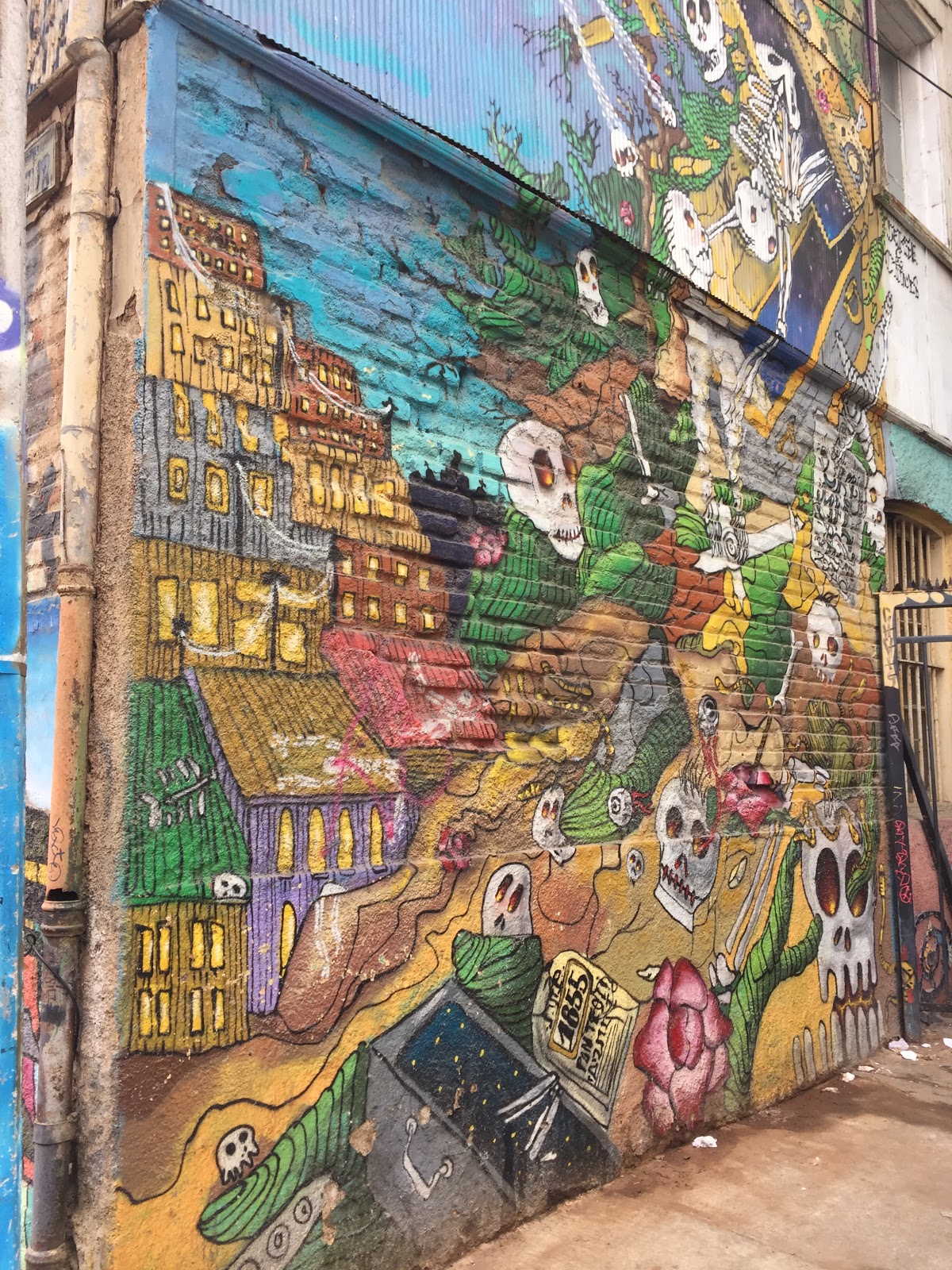
After the others left, I decided to visit the third largest city of Valparaiso, the most important port since  I hadn’t been there since 1968. It is built on steep hillsides with stairs, narrow alleyways, and elevators. I also wanted to see the famous street art. I took a free tour, just as Paula and I had done in Lisbon. It was a good tour and I also wandered on my own and saw more. I’m glad I stayed on and made the trip. I also got to visit some women that I had met the year before, friends of Erica’s, Ann and Gloria. They live in a small town Olmué in a lovely home with a beautiful garden with flowers, fruit bushes and trees, cacti, and vegetables.

Street art in Valparaiso
It was an amazing trip even though the weather wasn’t great. Progress is being made in Chile as it becomes more developed; we didn’t see oxen plowing fields, only tractors, and huasos (cowboys) on horses are now a rare sight. Women were flag persons in constructions zones. We had a good time, and met some very nice people. The best part was of course being together again, chatting and laughing and enjoying each other’s company. We enjoyed Chilean wine and some wonderful fish and seafood. Erica and her husband, Pillallo, were wonderful hosts.

Lynda, Glenda, Pillallo, Darlene, Erica, Susan